
SEND information
Our vision
Hillside Primary School is ambitious for all our pupils, and we believe that there is no ceiling on what can be achieved by anyone, regardless of their circumstances or background. We are committed to providing a supportive and inclusive learning environment, giving every young person the opportunity to fulfil their potential now, and in the future. The leaders at Hillside Primary School are leaders for all pupils, enabling our teachers to be teachers of all pupils.
Hillside Primary School is committed to distributed leadership to secure the best possible provision and outcomes for pupils with special educational needs. We have the same ambition for all our pupils, and recognise the importance and impact of prioritising our responsibilities to pupils with special educational needs. We work in partnership with pupils and their families in identifying and providing for special educational needs. Where appropriate, we also work in partnership with other agencies. We recognise the importance of communication being inclusive, accessible and culturally sensitive to achieve effective partnership working.
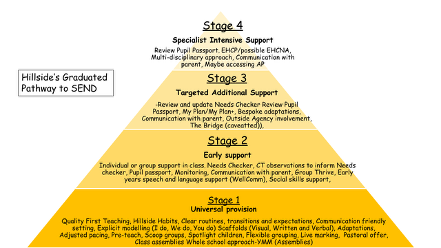
Graduated response
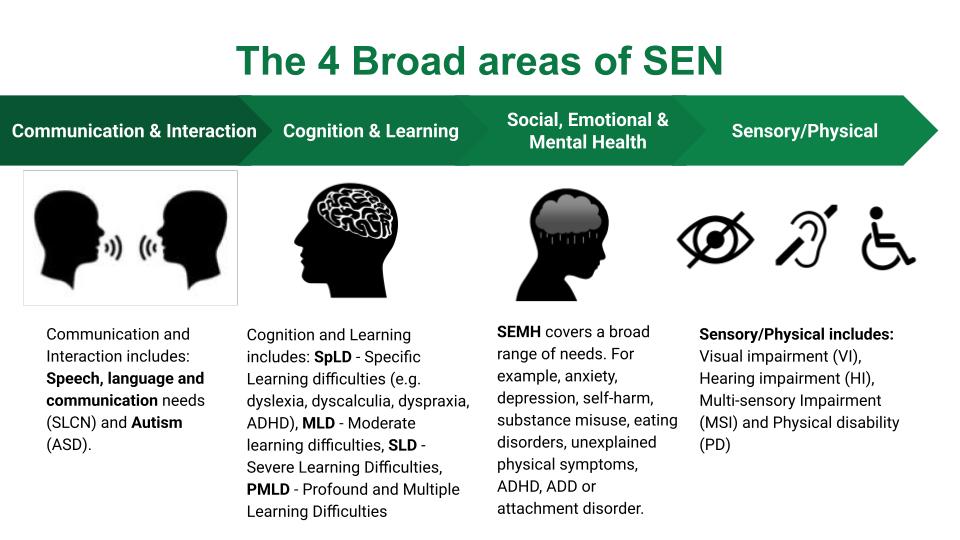
What does it mean to have a Special Educational Need?
A pupil has SEN if they have a learning difficulty or disability that requires special educational provision to be made for them. They have a learning difficulty or disability if they have a significantly greater difficulty learning than most others of the same age, or a disability that prevents or hinders them from making use of facilities of a kind generally provided for others of the same age in mainstream schools.
A day in the life at Hillside Primary School: practical exemplification
To understand how this looks in practice, let us follow a pupil who accesses our integrated support framework:
Morning arrival and soft start: The child arrives at school and enters through 'The Snug' pastoral hub for a 'soft start'. Instead of navigating a busy playground, they enter a calm, low-pressure environment to ensure they are emotionally 'classroom-ready'. Staff use clear visual cues using widget symbols to preview the day's schedule, mitigating transition anxiety.
In the classroom: During a reading lesson, the class teacher employs the "I Do, We Do, You Do" explicit instruction framework. The physical space features a neutral learning environment with Hessian backing to limit sensory overload. The student utilises a tinted reading ruler and accesses a pre-teaching vocabulary card developed in line with their personalised Pupil Passport, allowing them to participate side-by-side with peers via adaptive teaching rather than a lowered curriculum bar.
Social times and proactive regulation: At break time, the pupil accesses our triaged wristband system to spend time in 'The Snug' or the soft play facilities in the Top Hall, participating in structured, adult-led social interactions. If dysregulation occurs, the student proactively utilises a designated sensory break to reset before returning to their learning journey.
Our SEND team
|
Mrs Dare, SENDCo |
“My vision as SENDCo is to cultivate an inclusive, safe, and nurturing environment where every child's unique needs are fully met. Together, we remove barriers to enhance their learning, empowering every individual to thrive and truly be the BEST that they can be." |
|
Mrs Collier-Hall, |
“Every child has the right to an education that enables them to thrive. I believe that learning is most effective when children are engaged, motivated, and immersed in rich educational experiences. I am passionate about ensuring that every child at Hillside Primary School has access to the support and adjustments they need, at the right time, so that they can participate fully in school life and fulfil their potential.” |
|
Miss Hendry, |
“I enjoy supporting children to meet their full potential. Working on a 1:1 basis, making relationships with the children and helping them to feel safe. I love making learning fun and accessible for each child and helping every child to achieve their full potential!” |
|
Mrs Kelly, |
"I am passionate about supporting every child’s unique learning journey. For me, the key to great learning is creating a fun and nurturing environment where children feel confident to try new things. As an Intervention Teaching Partner, I love being able to adapt my approach to meet the individual needs of each child. There is nothing more rewarding than seeing a child make progress, not just academically but also in their self-belief and confidence!” |
Identification and assessment of children with SEND
Our identification process is rigorous and multi-faceted, focusing on removing barriers to learning as soon as they arise:
Transition and induction: transition to school is carefully planned to allow time for purposeful observations and developmental milestone monitoring. All early years pupils are systematically screened using the specialist WellComm Speech & Language toolkit to capture communication barriers immediately.
Data-driven tracking: class teachers make regular, formalised assessments. We identify students whose progress is significantly slower than peers from the same baseline, fail to match previous progress rates, or widen the attainment gap despite high-quality targeted support.
The Needs Checker tool: high-quality classroom observations provide evidence to complete our internal diagnostic 'Needs Checker'. This holistic profiling form breaks down difficulties into small-step descriptors across the four broad areas of need, establishing a robust foundation for subsequent Assess, Plan, Do, Review (APDR) cycles.
Parental and pupil voice: parental insights are treated as a critical component of initial assessments. We engage in initial 'contextual dialogues' with families, ensuring that the voice of the child directly shapes the tailored adjustments in their documentation.
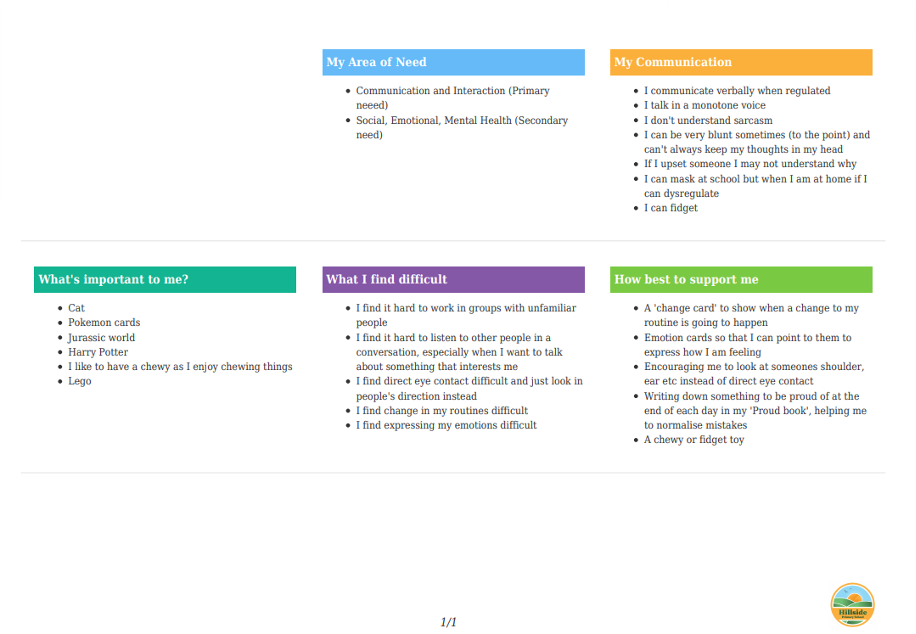
Pupil Passport
A pupil passport is a regularly reviewed document that contains the needs, strengths and individual strategies to support for every child with an EHCP or on SEN Support.
There are also circumstances when a Pupil Passport is used to support children that are not on our SEND register and where adaptations help them to be successful in the classroom.
Our Pupil Passports are developed in partnership with pupils and their parents/carers. Where appropriate, they might also include strategies recommended by other professionals.
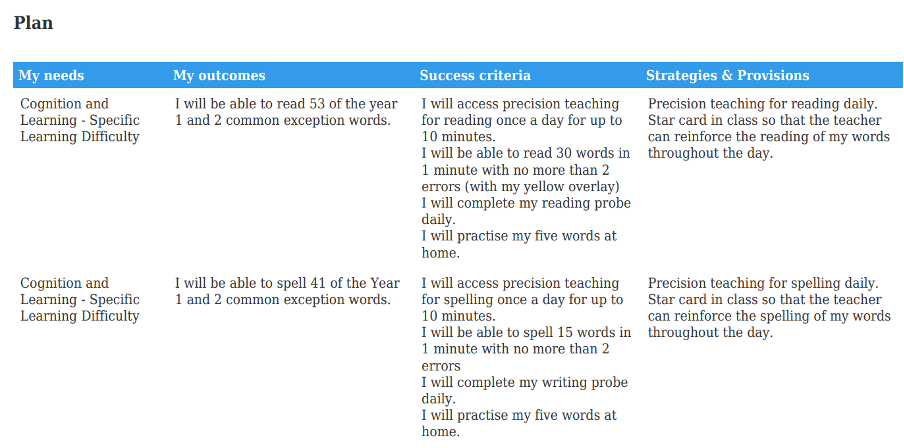
My Plan
Some pupils who require more specialised support will have Individualised ‘My Plans’ to complement pupil passports. For example, an individualised My Plan is a personalised support document for children with special educational needs and disabilities (SEND). It co-ordinates support between teachers, parents and health professionals for individuals who need extra help but do not meet the strict threshold for a formal statutory education, health and care plan (EHCP). It outlines specific goals, adjustments and who is responsible for providing support.
Universal provision – high quality teaching
Hillside Primary School ensures that a universal provision of high-quality teaching addresses gaps in foundational knowledge and skills. Through evidence-informed classroom routines and a well-planned curriculum, teachers address reading fluency, communication skills, writing composition, and core mathematical facts. Classrooms feature a sensory-aware environment with neutral tones, hessian display backings, and non-white backgrounds on visual presentations to eliminate glare and reduce sensory load. Class teachers will make visual, verbal and written adaptations to support all learners within the classroom.
Targeted support
Delivered by our specialised Intervention Teaching Partners, targeted support includes evidence-informed frameworks such as Freshstart and Read, Write, Inc. Fast Track Tutoring for phonological mastery, Precision Teaching for fluency, Number Sense for mathematical automaticity, and the Thrive Approach for emotional development
Specialist support
For complex profiles, we partner closely with the Educational Psychology Service, Advisory Teaching Service (including VI/HI and Communication specialists), Specialist Speech and Language Therapy (SALT),Occupational Therapy (OT), and commissioned clinical Play Therapy. Recommendations are immediately integrated into daily teacher planning and reviewed via the APDR framework to hold the school accountable for delivery.
Learning environments and adapted pathways
The Bridge Provision: A specialised internal hub for up to eight pupils presenting with complex SEMH needs. It focusses intensely on emotional regulation and therapeutic delivery of the curriculum while keeping students actively integrated with their main peer groups.
'The Snug': Our dedicated pastoral hub is divided into three distinct zones: the Thrive Zone for emotional interventions, the Clinical Zone for specialist therapeutic consultations, and the Pastoral Zone for immediate access to emotionally available adults via a triaged wristband system.
Sensory-Led Curriculum Pathway: Designed for non-speaking pupils or those facing profound engagement barriers. Progress on this pathway is monitored using specialised assessment frameworks like the Cherry Tree Garden rather than chronological year-group metrics.
Staff training
Staff coaching and confidence: The school prioritises dedicated time for the SENDCo to work directly alongside other staff members through coaching to build classroom expertise, confidence, and competence.
Teaching partners: A dedicated team of teaching partners receive specialised training with a specific focus on Cognition and Learning interventions and provision.
Thrive practitioners: Select staff members receive advanced training in specific specialisms, including teaching partners who are fully trained as Thrive Practitioners.
De-escalation training: There are twelve members of staff who are Level 2 Team Teach trained, focusing heavily on de-escalation strategies.
Completed and upcoming training: Specific SEND training has already been delivered on The Graduated Pathway and Pupil Passports. Upcoming scheduled training will focus on supporting pupils with Cognition and Learning needs as well as Speech and Language needs.
Useful links
Teacher Handbook: SEND
With contributions from specialists across the sector, the handbook is a comprehensive resource for teachers and parents to use over time. It brings together practical examples of high-quality teaching – placing focus on removing barriers to learning, getting to know and understand individual learners, and bringing to life the graduated approach. To access this free resource, click on the link below and sign up to Whole School SEND:
Whole School SEND Online CPD Units
Free, flexible online learning to help develop inclusive practice.
Link to the SEN Information Report and Local Offer can be found here.